
Aluminum-clad wood is a hybrid construction: a solid wood window or door core, wrapped on its exterior-facing surfaces in an extruded aluminum shell. The wood does what wood does best. It insulates, it machines cleanly for sightlines and hardware, and it takes a stain or paint to match any interior trim package. The aluminum does the one thing wood alone can't hold up to over time in Southern California's sun and marine air: it takes the weather.
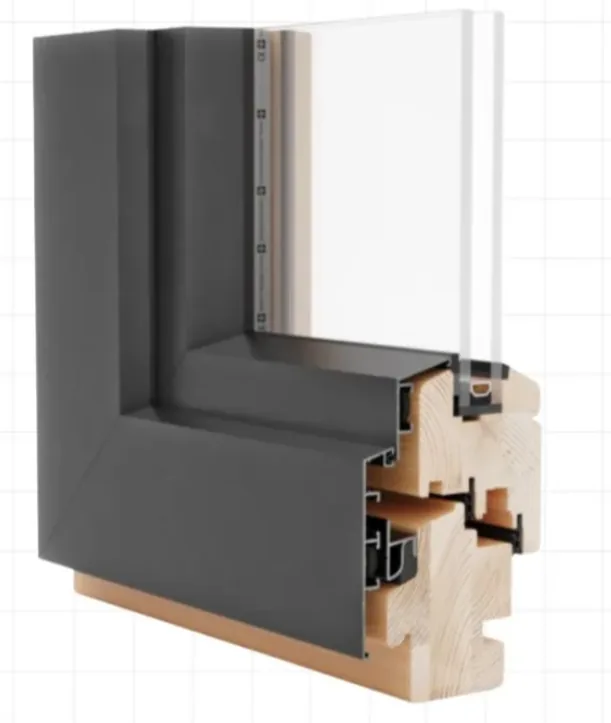
Where the aluminum stops and the wood begins
In the cutaway above, the two materials split cleanly along the line where weather exposure stops. The dark aluminum jacket wraps the entire exterior-facing profile, up the outer leg, over the top of the sightline, and down around the sill nose, so every surface that will see direct sun, wind-driven rain, or coastal salt air is aluminum, not wood. Behind that shell, the pale wood core carries the frame's structure and forms the entire interior-facing leg, left exposed to be primed, stained, or painted to match the room. The two are mechanically fastened together as one unit, not glued or wrapped as a veneer, so the cladding stays a true rigid shell rather than a laminate that can eventually separate.
Why cladding changes the maintenance cycle
That split matters because it isolates the failure mode. Bare exterior wood on a window or door takes on moisture through end grain and checking in the finish, and UV breaks down an exterior paint or stain film years before the interior side shows any wear, which is why unclad wood windows on a west- or south-facing elevation need repainting or refinishing on a cycle the rest of the house doesn't. It only takes one gap in the shell to undo the whole system. A sill horn, mitered corner, or interior return left uncovered on a weather-facing surface gives moisture the same opening it would have on a fully unclad window, and the wood core rots there regardless of how well the rest of the unit is protected. Move that exposure onto aluminum instead, and the maintenance cycle changes entirely: the factory-applied anodized or powder-coat finish on the cladding is baked on and UV-stable, so the exterior face doesn't need repainting, doesn't check or crack, and doesn't take on water at the joints the way an exposed wood sill does. The wood interior, protected from weather by the building itself, ages the way interior millwork ages, slowly, and on the owner's finish schedule, not the manufacturer's maintenance schedule.
When to specify aluminum-clad wood over all-wood or all-aluminum
For architects working coastal and hillside sites across our four Southern California showrooms, that's the specification logic behind reaching for aluminum-clad wood over an all-wood or all-aluminum unit: the aluminum exterior holds up to marine layer, direct sun exposure, and wind-driven rain without repainting, while the wood interior still delivers the warmth, sightline flexibility, and finish options an all-aluminum frame can't match on the room side. We carry this construction primarily through Kolbe and Lincoln, both engineered as a true mechanically fastened aluminum shell over a solid wood core rather than a wrapped veneer, and we've specified it across projects from Hidden Hills to Woodland Hills where the exterior elevation needed to read as a clean, low-maintenance material and the interior needed to read as wood.
Bring us a plan set and we'll work through where aluminum-clad wood fits the elevation versus an all-aluminum or steel-look system. See the full product range or visit a showroom to see a cut sample in hand.
Featured lines: Kolbe, Lincoln.