
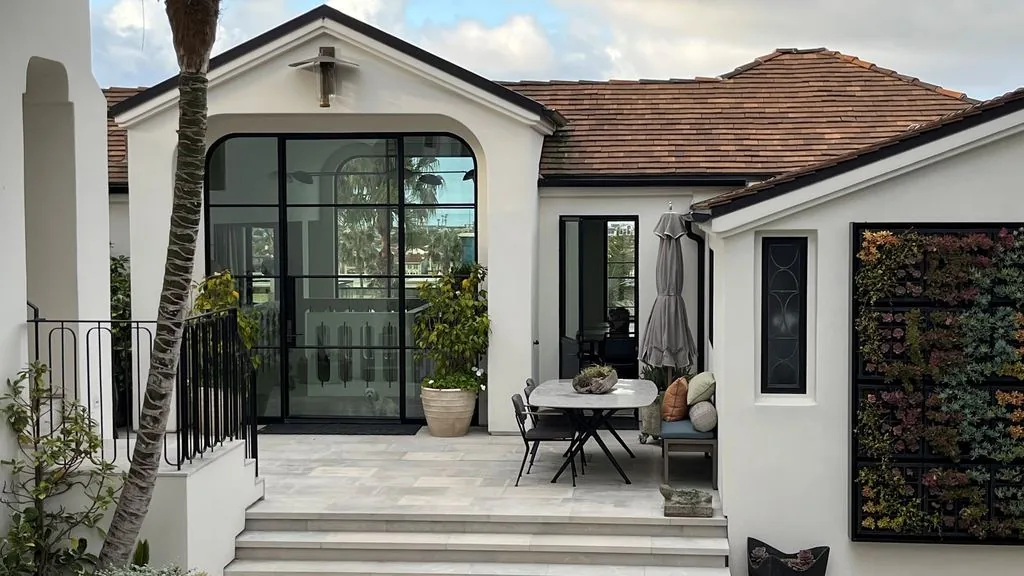
Steel gets specified for different reasons in different parts of Southern California. On the Westside it is usually chosen for minimalism: the narrowest possible frame around the largest possible sheet of glass. In Santa Barbara and Montecito the reasoning runs the other way. Steel is chosen because it is what the architecture was originally built with, and because a divided-lite steel window is the one thing that reads correctly on a Spanish Colonial Revival elevation.
That difference shapes the whole specification. Below is what tends to matter on South Coast projects, and where the decisions actually get made.
Why Santa Barbara asks for steel more than any other market
Santa Barbara has an unusually consistent architectural character, and it is not accidental. After the 1925 earthquake destroyed much of the downtown, the city rebuilt to a deliberate Spanish Colonial Revival vocabulary and put an architectural review process behind it. A century later that character is still enforced, and it still governs what a window is allowed to look like.
The houses that vocabulary produced, along with the Mediterranean Revival estates through Montecito and Hope Ranch, were glazed with iron and steel casements. Narrow dark frames, divided lites, deep reveals in thick stucco walls. When a homeowner on the South Coast says they want the windows to look right, that is almost always the reference, whether or not they can name it.
This is why steel comes up here more than anywhere else we work. It is not a contemporary preference imported onto an old house. It is the original material, and the modern version of it is the closest available match.
Wrought iron windows: what people ask for, and what gets specified
A large share of what we get asked for in this market is described as wrought iron, so it is worth being precise about the terms.
True wrought iron is effectively no longer made. It was a specific material, low in carbon and threaded with slag, worked by hand at a forge, and commercial production of it ended long ago. Nobody is manufacturing wrought iron window systems today.
What delivers that appearance now is hot-rolled steel. The distinction between hot-rolled and cold-rolled is the one worth understanding:
- Hot-rolled steel is formed at high temperature. It comes out with a slightly irregular surface and softer, less machined edges, which is what makes it read as traditional ironwork rather than as a modern extrusion.
- Cold-rolled steel is worked at room temperature and finishes more uniform and sharper edged. It suits contemporary elevations, and it is generally the wrong reference on a period house.
We carry Portella steel windows and doors, including thermally broken systems. For the engineering behind why steel holds so much glass on so little frame, our note on steel windows and doors as a hundred-year material works through the stiffness numbers and the service life.
What design review in Santa Barbara and Montecito expects
Most South Coast projects of any size pass through a review body. In the City of Santa Barbara that is typically the Architectural Board of Review, or the Historic Landmarks Commission where a property is designated or sits inside El Pueblo Viejo. Montecito is unincorporated county and runs through the Montecito Board of Architectural Review.
Guidelines change and each board applies judgment, so we do not publish thresholds. What is consistent is which properties of a window get examined:
- Proportion of the opening, and how it relates to the rest of the elevation
- The divided-lite pattern, and whether the lites are true, simulated, or applied
- Sightline width, meaning how heavy the frame reads from the street
- Finish and color, and whether it suits the period
- How deeply the unit is recessed into the wall, which is what gives a stucco opening its shadow line
The practical point is one of sequence. These are product decisions, and they are far cheaper to resolve before a submittal than after. When a window package is settled late, or changed after an approval, it can send a project back through review. Bringing the fenestration to a resolved state early is the most useful thing an owner or architect can do on a South Coast project.
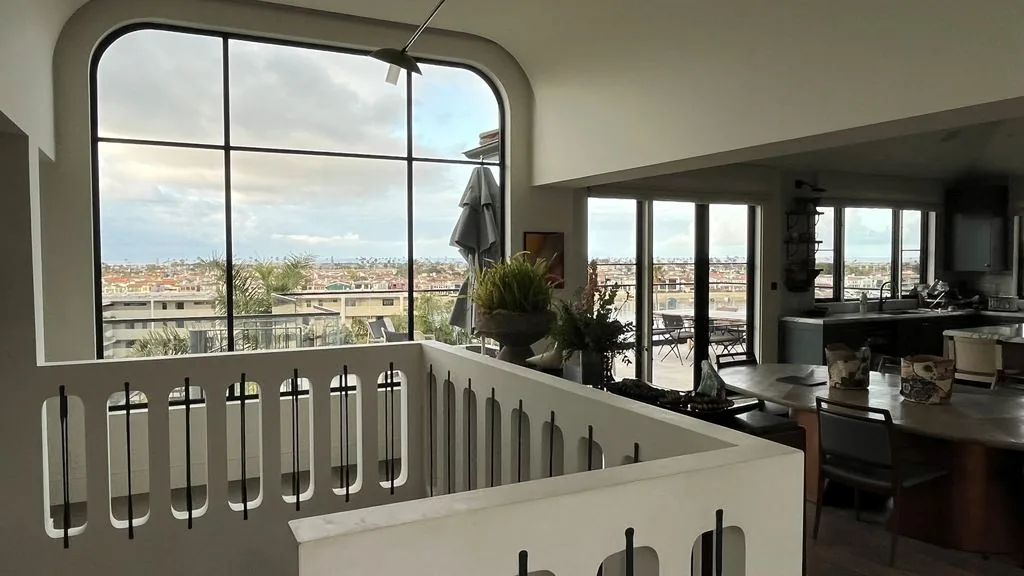
Steel on the South Coast: salt air, finish, and maintenance
Steel is protected by its coating, not by any corrosion resistance inherent to the metal. That is the difference between it and aluminum, which forms a protective oxide layer on its own surface. It is a manageable difference, but on the South Coast it deserves attention.
Carpinteria, Summerland, the lower reaches of Montecito and much of Hope Ranch sit close enough to the water for chloride exposure to be a genuine variable. On those sites, ask three questions before the order goes in:
- What is the finish system, and is it applied at the factory or in the field?
- What does the manufacturer's warranty say specifically about marine or coastal exposure?
- What is the maintenance expectation, and at what interval?
None of this argues against steel near the coast. Steel windows from the 1920s are still in service in far harsher climates. It argues for specifying the finish deliberately rather than accepting whatever is standard.
Does steel meet Title 24?
Thermally broken steel does. Steel conducts heat readily, so a solid steel section without a thermal break is difficult to bring to a compliant U-factor. A thermally broken frame places an insulating barrier inside the section, which lets the window reach its target without widening the sightline the architecture depends on.
Your required numbers are set by your project's climate zone, and they are revised on the state's code cycle, so we do not print values that will go stale. Our guide to knowing your windows meet Title 24 explains what U-factor and SHGC measure, and why the whole-window number is the one that counts rather than the number on the glass.
The compliance path and the design review path run at the same time, and they pull in opposite directions: one wants thermal performance, the other wants a narrow period-correct profile. Thermally broken steel is what satisfies both.
Seeing steel in person on State Street
Steel photographs poorly and reads clearly in person. Sightline width, the surface of a hot-rolled section, the way a dark finish behaves in daylight against stucco: these are the things that decide a specification, and they are hard to judge from a PDF.
Our Santa Barbara showroom at 3001 State Street serves the South Coast, including Montecito, Hope Ranch, Carpinteria, Summerland, and the Santa Ynez Valley. Visits are by appointment so a specialist is dedicated to your project. Bring a plan set, elevations, or your design review submittals, and we will work through opening sizes, operation types, glazing, finishes, and hardware, and return a specification ready for review and pricing.
Santa Barbara showroom: 805-570-5580. You can also see completed steel work in our project gallery.
Common questions
Can you still get wrought iron windows?
Not in the original sense. True wrought iron, the slag-bearing material worked by hand at a forge, has not been produced commercially at any scale for decades. What is specified today for that look is hot-rolled steel with a dark finish, which holds the same slender profile and the same visual weight while meeting current structural and energy requirements.
What is the difference between hot-rolled and cold-rolled steel windows?
Hot-rolled steel is formed at high temperature and carries a slightly irregular surface and softer edges, which is what makes it read as traditional ironwork. Cold-rolled steel is worked at room temperature and comes out more uniform and sharper edged, which suits contemporary elevations. On a Spanish Colonial Revival or Mediterranean house in Santa Barbara, hot-rolled is usually the closer match.
Do steel windows work in a coastal environment like Montecito or Carpinteria?
Yes, with the finish specified for it. Steel is protected by its coating rather than by any inherent corrosion resistance, so on the South Coast the finish system and the maintenance expectation matter more than they would inland. Ask the manufacturer what the coating system is, how it is applied, and what the warranty says about marine exposure.
Do steel windows meet Title 24 in California?
Thermally broken steel systems do. Steel conducts heat readily, so a frame without a thermal break is difficult to bring to a compliant U-factor. Thermally broken frames place an insulating barrier inside the section, which is what allows a steel window to hit its target without widening the sightline.
Will design review in Santa Barbara or Montecito approve steel windows?
Steel is generally the material these boards are looking for on Spanish Colonial Revival and Mediterranean work, because it is what the architecture was originally glazed with. Boards evaluate the specifics rather than the material itself: proportion, the divided-lite pattern, sightline width, finish, and how deeply the unit sits in the wall. Resolving those before submittal is what keeps a window from becoming a condition of approval.